Brine cooling block ice technology for large ice blocks, long melting time and transport-oriented applications.
Product Path
Block ice machine / Brine Cooling Tech
How brine block ice production works
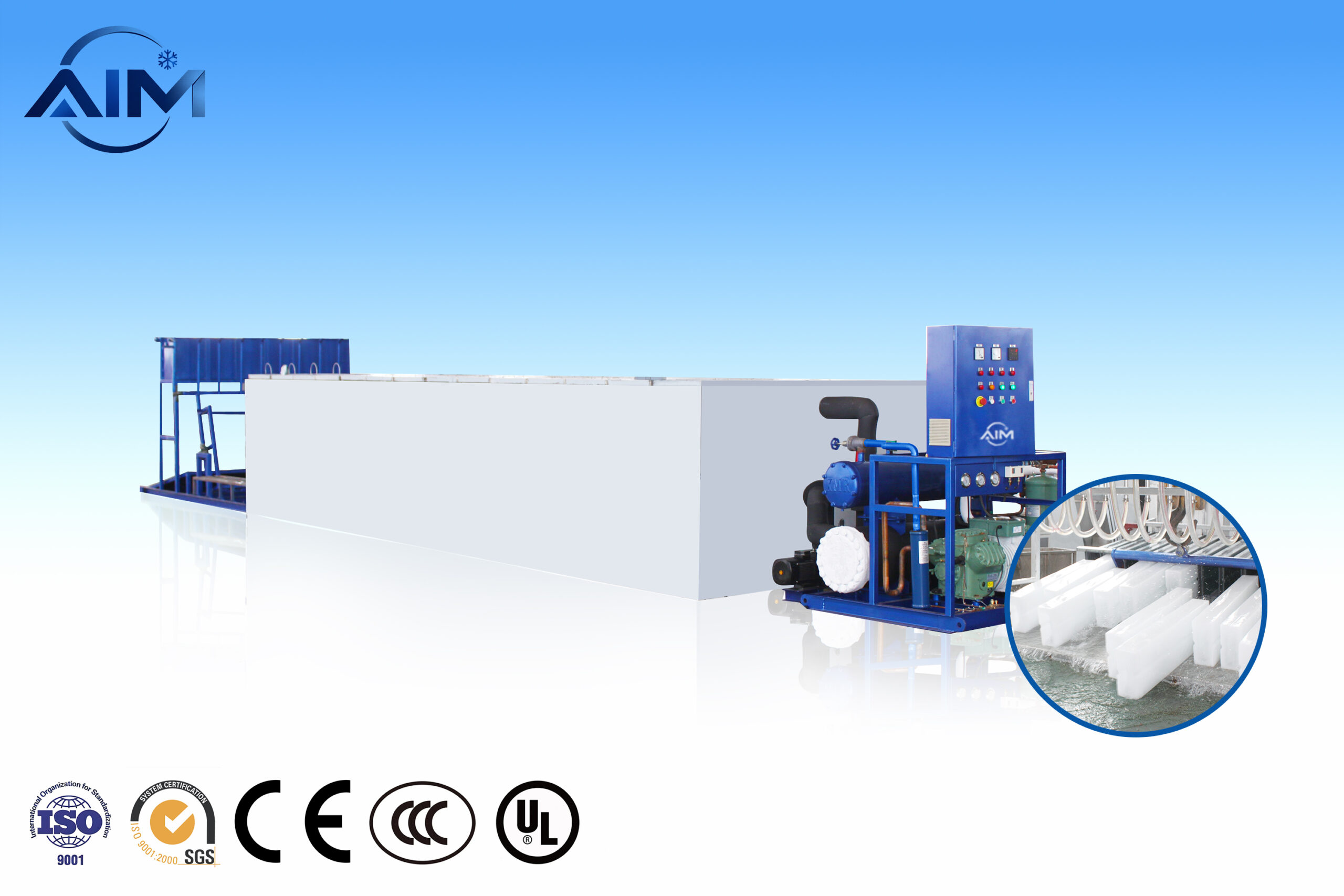
Brine block ice is a batch-freezing process built around an ice-can tank. Water is filled into individual cans, the cans are immersed in a refrigerated brine solution, and the brine is circulated around them to remove heat evenly. When the planned freezing cycle is complete, the cans are lifted and warmed or released through the harvest procedure so the solid blocks can be moved to storage, crushing or dispatch.
The brine is a secondary heat-transfer medium; under normal operation it does not contact the finished ice. Its concentration, temperature range, circulation rate and material selection must be coordinated with the refrigeration package. A poorly balanced brine loop can create uneven freezing, longer cycles, higher power use and unnecessary corrosion risk.
| Design item | Engineering role in the plant |
|---|---|
| Ice cans and block weight | Can dimensions, fill volume and target block weight determine the freezing surface, batch duration, lifting load and the handling equipment required after harvest. |
| Brine tank and circulation | Tank geometry, pump selection, agitation and brine distribution keep the temperature around the cans as uniform as possible and support repeatable freezing cycles. |
| Refrigeration package | The compressor, evaporating conditions, condenser route and controls are selected against daily output, water temperature, ambient climate and the required production schedule. |
| Concentration and corrosion control | Brine concentration is set for the design temperature and checked with the selected tank, piping, pump and heat-exchanger materials to protect heat transfer and service life. |
| Harvest and lifting route | Hoist or crane access, release space, drainage and the path to storage should be planned together so a completed batch does not interrupt the next cycle. |
| Storage and dispatch | For fishery, resale or industrial use, blocks may need a storage room, crusher, conveyor, weighing point or loading area sized to the real dispatch rhythm. |
Where brine block ice is the practical choice
AIM Refrigeration considers brine block ice when the project values large, durable blocks, long melt time and a familiar batch-production method. This route is common in fish markets, fishing ports, regional ice distribution and applications where blocks are stored, transported or crushed before use. It is less about the nameplate capacity alone and more about matching block weight, freezing cycle, labor, lifting and dispatch.
- Large blocks for seafood handling, transport cooling and regional ice sales
- Batch production where storage provides a buffer between freezing and dispatch
- Projects with a defined crane, hoist or assisted block-harvest workflow
- Ice plants that can manage brine inspection, cleaning and corrosion control as part of routine maintenance
What AIM confirms before selecting a brine system
A reliable selection starts with the operating brief, not only the requested tonnage. AIM reviews the required block weight, daily production, peak dispatch period, water condition, installation climate, electrical supply, available labor and the space for tank, refrigeration, harvest and storage. Where the project needs less brine handling or a more modular harvest arrangement, we also compare the direct-cooling route before finalizing the equipment path.
Subcategories and Models
AB-1T-BA
AB-1T-BA is positioned for single-room demand, pilot production and first-step commercial use, producing brine-cooled block ice for rugged handling and long melt time.
Check block mold size, freezing cycle and whether manual or assisted harvest is expected.
AB-2T-BA
Choose AB-2T-BA when the project calls for small daily sales where one extra production buffer matters and a practical brine-cooled block ice for rugged handling and long melt time path.
Check block mold size, freezing cycle and whether manual or assisted harvest is expected.
AB-3T-BA
AB-3T-BA gives buyers a 3-ton daily option for compact shops that need steadier output than a starter unit with room for future workflow planning.
Check block mold size, freezing cycle and whether manual or assisted harvest is expected.
AB-5T-BW
AB-5T-BW suits entry commercial projects balancing output, footprint and budget, especially when buyers are comparing site space, utilities and brine-cooled block ice for rugged handling and long melt time.
Check block mold size, freezing cycle and whether manual or assisted harvest is expected.
AB-10T-BW
AB-10T-BW gives buyers a 10-ton daily option for regional supply with several delivery or processing batches per day with room for future workflow planning.
Check block mold size, freezing cycle and whether manual or assisted harvest is expected.
AB-15T-BE
AB-15T-BE is positioned for two-shift operation where output stability becomes more important, producing brine-cooled block ice for rugged handling and long melt time.
Check block mold size, freezing cycle and whether manual or assisted harvest is expected.
AB-20T-BE
For industrial cooling rooms, ports or batching work with a fixed daily target, AB-20T-BE provides a capacity step that can be matched with storage or delivery equipment.
Review brine tank size, crane path, ice thawing area and block storage room together.
AB-30T-BE
Choose AB-30T-BE when the project calls for bulk dispatch sites that need storage and delivery equipment planned early and a practical brine-cooled block ice for rugged handling and long melt time path.
Review brine tank size, crane path, ice thawing area and block storage room together.
AB-40T-BE
AB-40T-BE suits high-volume plants with mechanical ice movement and longer operating hours, especially when buyers are comparing site space, utilities and brine-cooled block ice for rugged handling and long melt time.
Review brine tank size, crane path, ice thawing area and block storage room together.
AB-50T-BE
AB-50T-BE is positioned for central ice factories coordinating production, packing and truck loading, producing brine-cooled block ice for rugged handling and long melt time.
Review brine tank size, crane path, ice thawing area and block storage room together.
AB-60T-BE
Use AB-60T-BE for multi-shift plants serving several downstream buyers or departments; it fits projects where brine-cooled block ice for rugged handling and long melt time is part of the operating plan.
Review brine tank size, crane path, ice thawing area and block storage room together.
AB-70T-BE
AB-70T-BE is selected for large regional ice supply where storage, delivery and utilities must be engineered together rather than small-batch or occasional ice demand.
Review brine tank size, crane path, ice thawing area and block storage room together.
AB-80T-BE
AB-80T-BE gives buyers a 80-ton daily option for heavy-duty projects that need continuous output and a clear maintenance layout with room for future workflow planning.
Review brine tank size, crane path, ice thawing area and block storage room together.
AB-100T-BE
Choose AB-100T-BE when the project calls for turnkey-scale plants where production, storage and dispatch are designed as one system and a practical brine-cooled block ice for rugged handling and long melt time path.
Review brine tank size, crane path, ice thawing area and block storage room together.
Brine Cooling Tech models at a glance.
Nominal capacity and cooling route are shown for first-stage comparison. Final output depends on ambient temperature, inlet water temperature, voltage, operating hours and the complete site workflow.
| Model | Nominal capacity | Cooling route | Typical project fit | Details |
|---|---|---|---|---|
| AB-1T-BA | 1 ton/day | Brine / air-cooled | Local fishery or startup supply | View model |
| AB-2T-BA | 2 ton/day | Brine / air-cooled | Local fishery or startup supply | View model |
| AB-3T-BA | 3 ton/day | Brine / air-cooled | Local fishery or startup supply | View model |
| AB-5T-BW | 5 ton/day | Brine / water-cooled | Fishery and regional ice distribution | View model |
| AB-10T-BW | 10 ton/day | Brine / water-cooled | Fishery and regional ice distribution | View model |
| AB-15T-BE | 15 ton/day | Brine / evaporative-cooled | Fishery and regional ice distribution | View model |
| AB-20T-BE | 20 ton/day | Brine / evaporative-cooled | Fishery and regional ice distribution | View model |
| AB-30T-BE | 30 ton/day | Brine / evaporative-cooled | Fishery and regional ice distribution | View model |
| AB-40T-BE | 40 ton/day | Brine / evaporative-cooled | Large port or industrial ice plant | View model |
| AB-50T-BE | 50 ton/day | Brine / evaporative-cooled | Large port or industrial ice plant | View model |
| AB-60T-BE | 60 ton/day | Brine / evaporative-cooled | Large port or industrial ice plant | View model |
| AB-70T-BE | 70 ton/day | Brine / evaporative-cooled | Large port or industrial ice plant | View model |
| AB-80T-BE | 80 ton/day | Brine / evaporative-cooled | Large port or industrial ice plant | View model |
| AB-100T-BE | 100 ton/day | Brine / evaporative-cooled | Large port or industrial ice plant | View model |
Technical questions buyers ask before choosing Brine Cooling Tech.
These points help overseas buyers compare capacity, condenser type, project data and equipment scope before requesting a quotation from AIM Refrigeration.
What is the difference between brine block ice and direct cooling block ice?
Brine systems are often lower in initial cost and familiar for traditional block ice plants. Direct cooling systems avoid brine contact, can reduce manual handling and are often selected for cleaner operation and easier ice harvest.
How long does it take to freeze one batch of block ice?
Freezing time depends on block weight, water temperature, evaporating temperature, condenser performance and ambient climate. A technical quotation should be based on the required block size and daily production schedule.
Which condenser type is best for tropical block ice projects?
Water-cooled or evaporative-cooled condensers are often reviewed for hot climates when water supply and maintenance conditions allow. Air-cooled systems may be preferred where water is limited.