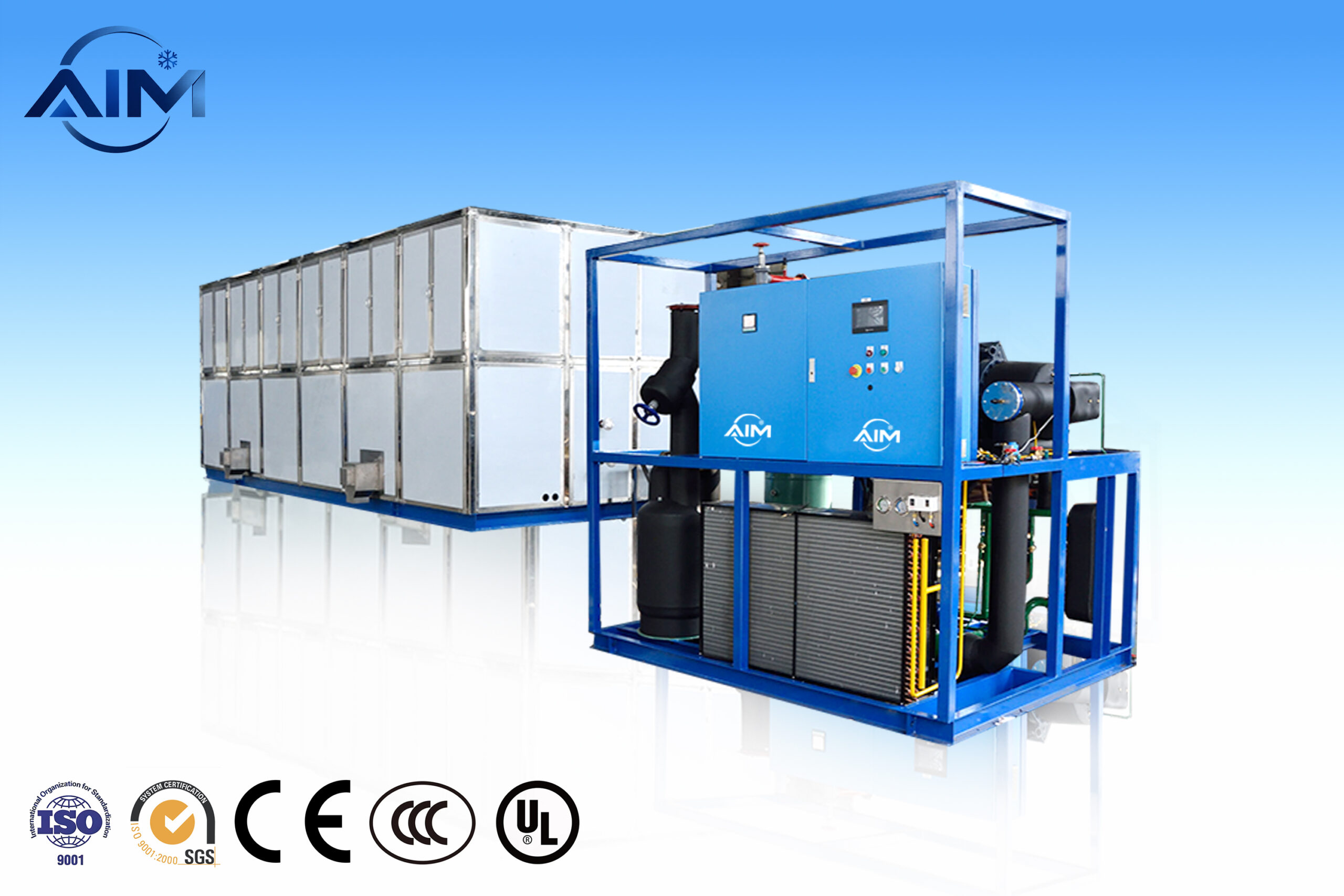
Cube ice machines produce regular, customer-facing ice for beverage service, hotels, restaurants, convenience stores, retail ice bags and central ice supply projects.
Built for beverage quality and consistent ice appearance
Cube ice is often judged by the end user before it is judged by the plant manager. Shape, clarity, hardness, hygiene and melt behavior all affect how the ice performs in drinks, display counters and retail bags. AIM Refrigeration reviews water treatment, evaporator design, harvest rhythm, storage hygiene and downstream packing before recommending a cube ice system.
Regular ice shape
Uniform cube size helps beverage service, retail packaging and brand presentation look consistent.
Filtration and sanitation
Clear edible ice depends on stable water supply, filtration, cleaning access and hygienic handling after harvest.
Bin and bagging layout
Cube ice should move from production to storage and packing without unnecessary melting or manual contamination.
Condenser selection
Air-cooled, water-cooled and evaporative-cooled options should be matched to room ventilation, water availability and climate.
Where cube ice is usually selected
| Buyer type | Selection focus |
|---|---|
| Hotels and restaurants | Clean ice appearance, daily peak demand, compact storage and simple operation. |
| Beverage chains | Stable cube size, predictable harvest and enough storage for service peaks. |
| Retail ice suppliers | Bagging workflow, ice hardness, storage time and delivery route planning. |
| Central kitchens | Food-contact hygiene, water treatment, drainage and easy cleaning access. |
Quotation data for cube ice projects
- Daily cube ice demand and expected peak-hour consumption
- Application: drinks, retail bags, hotel service, supermarket or central kitchen
- Preferred cube size, ice clarity requirement and water treatment condition
- Storage bin volume, packing method and delivery schedule
- Installation country, voltage, ambient temperature and available ventilation
Cube ice machine model range
AC-1TA
For this smallest cube unit, verify counter demand, water filtration and the space left for a compact bin.
AC-2TA
Before quoting this two-ton model, check peak beverage hours and whether a larger ice bin is needed.
AC-3TA
For three-ton cube production, compare daily retail bags, cleaning access and condenser ventilation.
AC-5TW
Match this five-ton cube model with bag size, storage bin volume and operator loading method.
AC-10TW
Check whether the ten-ton output will feed retail bags, a beverage chain or a central storage room.
AC-15EC
Plan water treatment, harvest schedule and downstream handling before selecting the fifteen-ton cube line.
AC-20EC
For twenty-ton cube supply, confirm storage buffer, dispatch rhythm and maintenance access.
Need a cube ice system for beverage or retail supply?
Send daily demand, cube use and site data. AIM Refrigeration will help match capacity, cooling method and storage layout.
Cube ice machine models at a glance.
Nominal capacity and cooling route are shown for first-stage comparison. Final output depends on ambient temperature, inlet water temperature, voltage, operating hours and the complete site workflow.
| Model | Nominal capacity | Cooling route | Typical project fit | Details |
|---|---|---|---|---|
| AC-1TA | 1 ton/day | Air-cooled | Starter beverage and retail supply | View model |
| AC-2TA | 2 ton/day | Air-cooled | Starter beverage and retail supply | View model |
| AC-3TA | 3 ton/day | Air-cooled | Starter beverage and retail supply | View model |
| AC-5TW | 5 ton/day | Water-cooled | Commercial packaged ice | View model |
| AC-10TW | 10 ton/day | Water-cooled | Commercial packaged ice | View model |
| AC-15EC | 15 ton/day | Evaporative-cooled | Regional or industrial ice supply | View model |
| AC-20EC | 20 ton/day | Evaporative-cooled | Regional or industrial ice supply | View model |
Technical questions buyers ask before choosing Cube ice machine.
These points help overseas buyers compare capacity, condenser type, project data and equipment scope before requesting a quotation from AIM Refrigeration.
What information is needed to quote a cube ice machine?
AIM usually needs daily ice output, cube size, installation country, voltage, ambient temperature, inlet water temperature, cooling method preference and whether storage or bagging is required.
Which cube ice capacity is suitable for a new ice business?
Small daily output is usually used for stores, restaurants or test markets. Larger industrial cube ice systems are selected when the buyer plans wholesale ice bags, supermarket distribution or multi-shift production.
Can the cube ice machine be configured for tropical climates?
Yes. For hot and humid locations, AIM reviews ambient temperature, condenser ventilation and water conditions before recommending air-cooled, water-cooled or evaporative-cooled heat rejection.