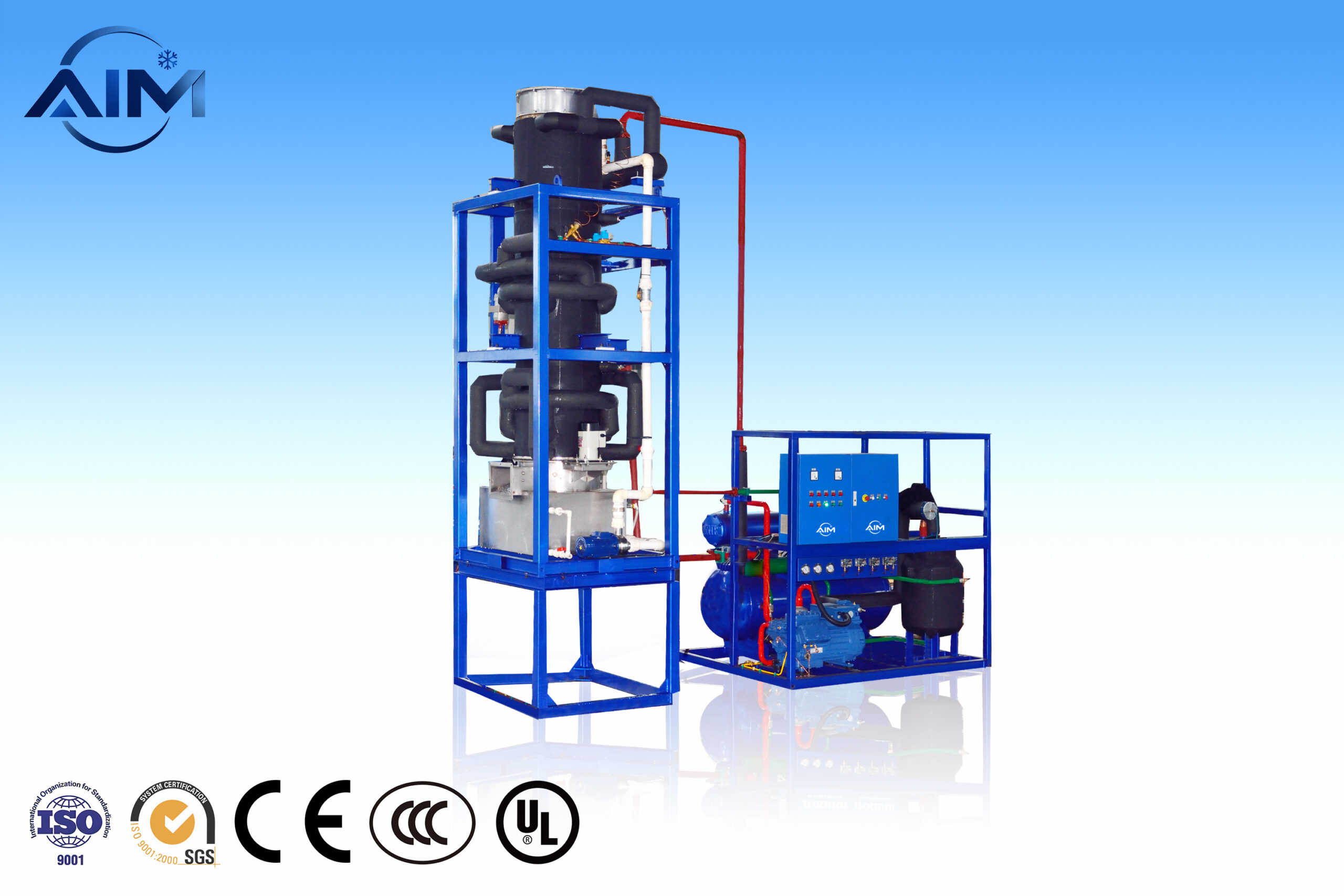
Tube ice machines produce hard cylindrical edible ice for ice factories, beverage cooling, supermarkets, fish markets, packed ice distribution and large daily supply.
Designed around the edible ice production line
Tube ice is commonly selected when buyers need clean ice that stores well, packs efficiently and travels through distribution without breaking down quickly. For a professional ice factory, the machine is only one part of the line. Water chilling system, ice harvesting, storage, weighing, bagging, cold-room holding and truck loading should be planned as one workflow.
Stable daily output
Tube ice projects often run by daily production targets, storage buffer and packing throughput.
Hard ice with a hollow center
The cylindrical shape provides good handling strength and suitable melting behavior for beverage and retail use.
Storage and packing
Ice bins, conveyors, weighing machines and bagging areas should match the machine capacity.
Edible ice handling
Water chilling system, food-contact surfaces, drainage and clean packing space are important for edible ice buyers.
Tube ice plant workflow
Key decisions before selecting capacity
| Decision | Why it matters |
|---|---|
| Tube diameter | Different markets may prefer different ice size for drinks, bags or cooling use. |
| Packing speed | A high-output machine can still bottleneck if weighing and bagging are too slow. |
| Storage hours | Storage capacity should cover night production, peak orders and truck loading windows. |
| Cooling method | Condenser choice affects energy use, installation space and performance in hot climates. |
Quotation data for tube ice projects
- Required daily output and working hours
- Tube diameter preference and edible ice quality requirement
- Packing method: manual, semi-automatic or automatic bagging
- Storage bin or cold room capacity
- Installation country, voltage, water temperature and ambient temperature
Tube ice machine model range
AT-1TA
Confirm tube diameter, water treatment and whether the buyer needs ice for drinks or small bags.
AT-2TA
Check bin size and harvest frequency so the small machine does not idle during peak hours.
AT-3TA
Review edible-water treatment, drain position and manual packing expectations.
AT-5TW
Match the five-ton tube unit with a bin, scale and simple bagging area.
AT-10TW
Review packing speed, storage hours and truck loading rhythm before selection.
AT-15TE
Confirm whether automatic weighing or semi-automatic bagging should be prepared.
AT-20TE
Plan storage buffer, delivery height and packing line position with the ice maker.
AT-25TE
Check if one machine room will support several packing or loading points.
AT-30TE
Coordinate ice storage, elevator height and bagging speed for the full daily output.
AT-40TE
Treat storage, delivery and packing as a complete line rather than one machine.
AT-50TE
Review condenser condition, ice elevator length and bagging-machine throughput together.
AT-60TE
Prepare a plant layout that separates production, storage, packing and forklift movement.
AT-70TE
Confirm whether the buyer needs redundant operation or a single high-output line.
Planning an edible tube ice plant?
Send output, tube size, packing plan and site data. AIM Refrigeration will review the complete production workflow.
Tube ice machine models at a glance.
Nominal capacity and cooling route are shown for first-stage comparison. Final output depends on ambient temperature, inlet water temperature, voltage, operating hours and the complete site workflow.
| Model | Nominal capacity | Cooling route | Typical project fit | Details |
|---|---|---|---|---|
| AT-1TA | 1 ton/day | Air-cooled | Pilot or compact edible ice plant | View model |
| AT-2TA | 2 ton/day | Air-cooled | Pilot or compact edible ice plant | View model |
| AT-3TA | 3 ton/day | Air-cooled | Pilot or compact edible ice plant | View model |
| AT-5TW | 5 ton/day | Water-cooled | Commercial ice distribution | View model |
| AT-10TW | 10 ton/day | Water-cooled | Commercial ice distribution | View model |
| AT-15TE | 15 ton/day | Evaporative-cooled | Industrial packaged ice plant | View model |
| AT-20TE | 20 ton/day | Evaporative-cooled | Industrial packaged ice plant | View model |
| AT-25TE | 25 ton/day | Evaporative-cooled | Industrial packaged ice plant | View model |
| AT-30TE | 30 ton/day | Evaporative-cooled | Industrial packaged ice plant | View model |
| AT-40TE | 40 ton/day | Evaporative-cooled | Industrial packaged ice plant | View model |
| AT-50TE | 50 ton/day | Evaporative-cooled | Industrial packaged ice plant | View model |
| AT-60TE | 60 ton/day | Evaporative-cooled | Industrial packaged ice plant | View model |
| AT-70TE | 70 ton/day | Evaporative-cooled | Industrial packaged ice plant | View model |
Technical questions buyers ask before choosing Tube ice machine.
These points help overseas buyers compare capacity, condenser type, project data and equipment scope before requesting a quotation from AIM Refrigeration.
How does ambient temperature affect tube ice output?
Higher ambient temperature and warmer inlet water reduce refrigeration efficiency. AIM sizes the compressor, condenser and evaporator by local climate data rather than relying only on nominal capacity.
What tube ice size can be supplied?
Tube ice diameter and length are selected according to the final use, such as beverage service, bagged ice sales, fishery cooling or food processing.
What should buyers prepare before ordering a tube ice plant?
Prepare target daily output, ice size, voltage, frequency, water temperature, ambient temperature, storage plan, packing method and installation country.