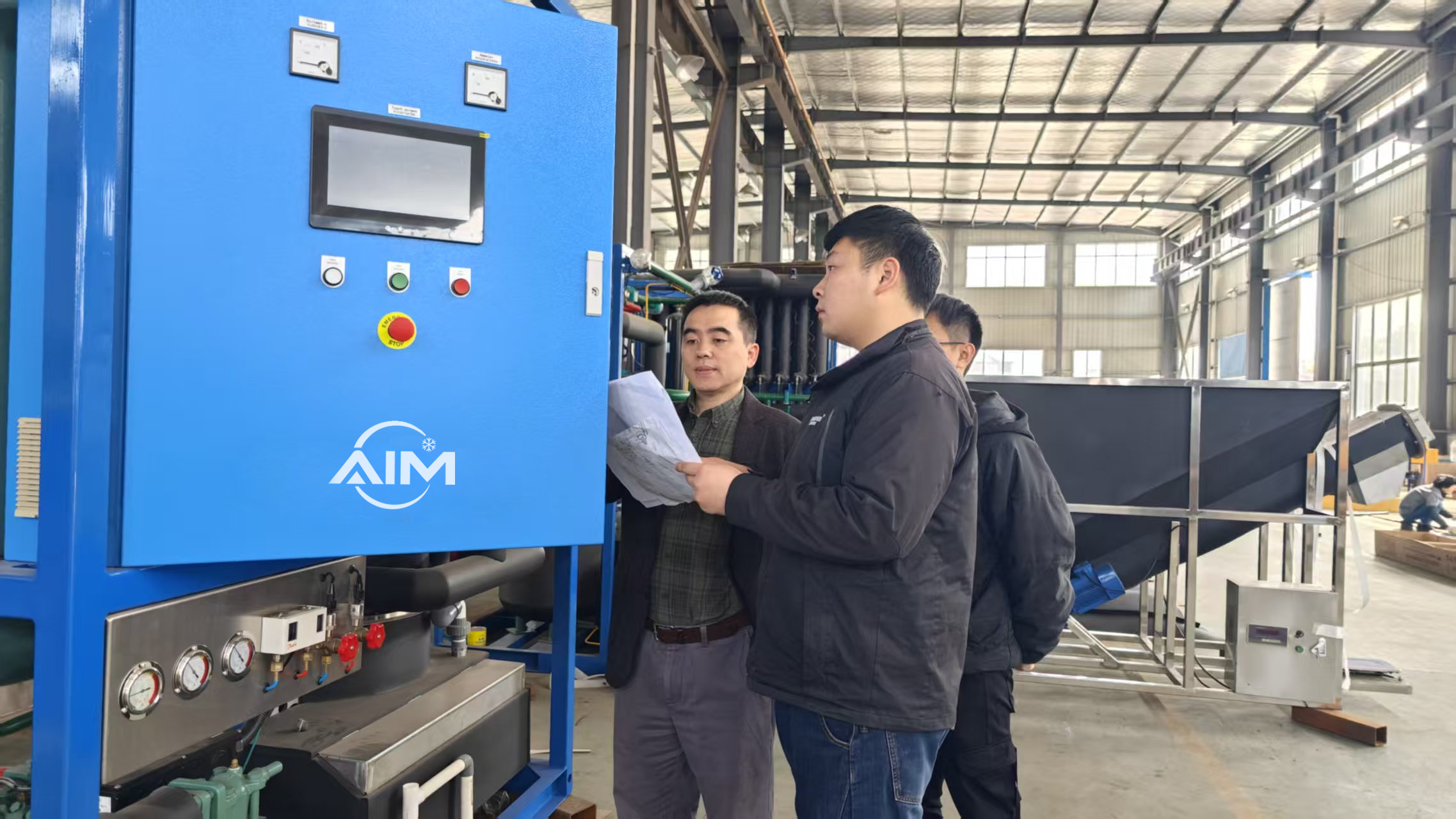
An industrial ice plant for packaged ice should be specified as a production-and-handoff system, not simply as an ice machine. AIM’s product catalog identifies tube and cube ice as relevant to packaged ice businesses and asks buyers to consider ice type, daily output, storage volume, working hours and the wider delivery arrangement together. That is useful because a machine can make the right ice form while the bagging, temporary storage or dispatch handoff still limits the operation.
This brief helps a buyer turn a commercial requirement into a clear request for engineering selection. It does not assume a particular output, bag size, packing speed or installation arrangement. Those values must come from the operator’s own sales plan, production schedule and site survey.
Start with the packaged-ice operating promise
Define what the operation is expected to supply before comparing ice technologies. Record the intended market, the ice form requested by that market, whether the product is sold loose or bagged, and when dispatch demand occurs. AIM describes tube ice as hard, clean and easy to store, transport and pack, while its catalog positions cube ice for beverage, hotel, retail and packaged-ice uses. That does not make either format universally suitable; it gives the project team a practical starting point for discussion.
Separate normal production from peak dispatch. A buyer may need the plant to replenish stock during a quiet period and release ice later when drivers or customers arrive. Write down the working hours, planned production windows, peak collection periods, and whether the same people operate production, packing and loading. These operational facts are more helpful to a quotation than an unspecific request for a large ice machine.
Describe the product handoff, not only the product
Map the path from machine discharge to the customer-facing package. Include where ice is received, how it is moved to storage, when it is weighed or bagged, where sealed bags wait for collection, and how rejected or spilled ice is handled. AIM notes that larger projects may need ice storage, screw conveying, weighing, packing and PLC control considered with the main equipment. A buyer does not need to prescribe every component, but should make the intended handoffs visible so the supplier can identify interfaces that need further design.
Choose the ice form around use and handling
Ask the sales and operations teams to agree on the required ice form before a model is discussed. The AIM catalog distinguishes cube ice, tube ice, block ice, flake ice, plate ice and slurry ice because different applications call for different handling and cooling characteristics. For packaged drinking ice, the relevant question is how the customer expects the ice to look, handle, store and be packed. Avoid treating a product name as a final specification.
Document any quality or hygiene procedures already required by the business, such as cleaning responsibilities, inspection points, bag handling rules and separation between production and dispatch work. Do not claim that a machine alone provides a site certification or an operating result. Instead, ask the supplier which equipment interfaces, cleaning access and operating information should be reviewed against the buyer’s own procedures.
Make storage a production buffer decision
Storage should be reviewed as a buffer between ice production and bagging or dispatch. The AIM catalog specifically lists storage volume and peak demand as selection factors. Record the desired buffer purpose: covering collection peaks, allowing production before packing, holding finished bags, or managing a temporary interruption in loading. Also note space, access route, floor loading review, drainage approach and the people or equipment that will move ice. These details help distinguish ice storage from finished-goods holding.
Collect utility and site information early
AIM asks buyers to provide application, capacity, country, voltage, ambient temperature and site conditions before quotation. For this project, prepare those items with the location of the machine area, storage area and bagging area. State the available water information, water quality information if known, heat-rejection constraints, electrical supply, ventilation considerations, drainage points and delivery route. If an item is unknown, label it as pending rather than guessing.
Review the physical sequence with the site team. Confirm where equipment can be installed, where bags and packaging materials enter, how operators reach service points, and how finished product leaves. This is also the time to identify whether another contractor owns building work, drains, electrical distribution or controls integration. A quotation can then state the boundary between refrigeration equipment and site work more clearly.
Quotation checklist
- Target ice form and intended packaged-ice market
- Planned operating hours, production windows and dispatch peaks
- Daily demand profile and the storage buffer purpose
- Bagging, weighing, storage and loading handoff sequence
- Available voltage, water information, ambient conditions and drainage points
- Machine, storage and packing-area dimensions plus delivery access
- Site responsibilities for civil work, utilities, controls and commissioning support
Attach a simple layout or annotated photographs when available. The aim is not to freeze the design before engineering review; it is to make the buyer’s workflow testable. AIM can then direct the inquiry to the appropriate product path and identify whether storage, conveying, weighing or packing coordination should be part of the technical discussion.
Ask for a focused next step
Send the completed brief with the product and schedule assumptions to AIM’s industrial refrigeration product catalog and request selection support through the AIM contact page. Ask the response to distinguish confirmed buyer inputs, equipment assumptions and site items that still need verification. That structure keeps an industrial ice plant for packaged ice tied to the real bagging handoff rather than to a catalogue comparison alone.
Technical questions buyers ask before choosing Industrial Ice Plant for Packaged Ice: Bagging Handoff Brief.
These points help overseas buyers compare capacity, condenser type, project data and equipment scope before requesting a quotation from AIM Refrigeration.
What data is needed for an AIM equipment quotation?
Share product type, required capacity, installation country, voltage, ambient temperature, inlet water or product temperature, operating schedule and application details.
Can AIM configure equipment for overseas projects?
Yes. AIM reviews climate, power supply, layout, capacity and workflow before proposing a suitable refrigeration or ice-making configuration.
Does AIM provide technical documents before purchase?
AIM can prepare quotation assumptions, model information and technical documentation according to the confirmed project scope.