Air-Cooled vs Water-Cooled Industrial Chiller: How Buyers Should Choose
Choosing an air-cooled vs water-cooled industrial chiller is not simply a matter of selecting the lower equipment price. The better choice depends on how the project can reject heat, what utilities are available, the required water temperature and flow, the installation environment, and how the process operates throughout the day. A useful comparison therefore starts with site and process data rather than a preference for one condenser type.
AIM Refrigeration reviews the cooling load, inlet and outlet water temperatures, flow rate, ambient conditions, condenser arrangement, pumps, buffer storage and operating pattern before proposing an industrial water chiller. This guide explains the main decision points that buyers should prepare before requesting a quotation.
Begin with the process duty, not the condenser name
Both air-cooled and water-cooled chillers remove heat from a process water or brine loop. The process side of the selection still needs the same basic information: the heat load, the target supply temperature, the return temperature, the required flow and the expected operating schedule. The condenser choice determines how the refrigeration system releases that collected heat to the surrounding environment.
This distinction matters because a project can have a correctly calculated cooling load but an unsuitable heat-rejection arrangement. For example, a site with limited outdoor space may struggle to place air-cooled condenser sections with adequate airflow. A water-cooled arrangement may be difficult where condenser water quality, water supply, treatment or cooling-tower maintenance cannot be supported. The decision must match the real installation conditions.
How an air-cooled industrial chiller rejects heat
An air-cooled chiller uses outdoor air across condenser coils to reject heat. It does not require a condenser-water loop or cooling tower. This can simplify the utility arrangement and reduce the number of water-side components that must be installed around the refrigeration package.
When air cooling is often a practical starting point
Air-cooled equipment is often considered when water availability is restricted, when the project team wants to avoid a cooling tower and condenser-water treatment, or when there is suitable outdoor space with clear airflow. It can also fit projects where a packaged arrangement is preferred and the process cooling duty can be served under the local design conditions.
What buyers must check before selecting it
The quotation should state the highest expected ambient temperature, installation altitude when relevant, available equipment area, clearance around the condenser and whether hot discharge air can recirculate. Buyers should also explain nearby walls, roofs, equipment or enclosed structures that may restrict airflow. Condenser noise requirements and access for coil cleaning should be discussed during layout review rather than after delivery.
Air-cooled capacity and efficiency are affected by the outdoor condition in which the condenser must operate. For that reason, a proposal based only on a nominal chiller capacity may not represent the actual project duty. AIM should receive the site climate and process data together.
How a water-cooled industrial chiller rejects heat
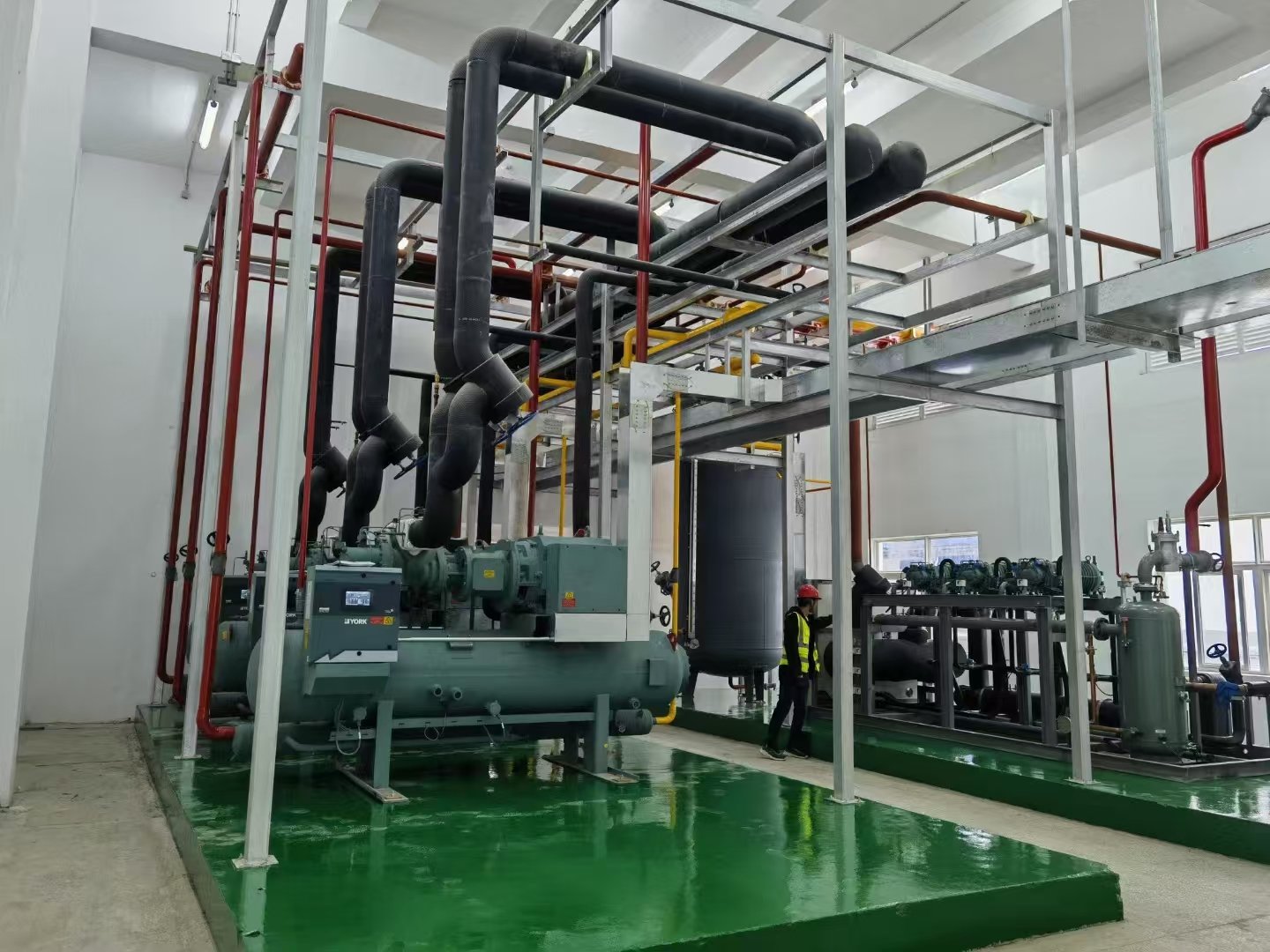
A water-cooled chiller transfers heat to a condenser-water circuit. That circuit normally works with a heat-rejection device and requires pumps, piping, controls and water management. The arrangement adds coordination work, but it can be appropriate for industrial plants that have suitable utilities, dedicated mechanical space and personnel able to maintain the complete water system.
When water cooling may fit the project
Water-cooled equipment is commonly evaluated for central process-cooling systems, larger continuous duties, mechanical-room installations and projects where condenser-water infrastructure is already available or can be planned as part of the plant. The final choice still depends on actual load, temperatures, climate, space and operating requirements.
What buyers must check before selecting it
The project team should confirm the condenser-water source, expected water condition, treatment plan, cooling-tower or other heat-rejection arrangement, pump scope, pipe distance and maintenance responsibility. Water quality cannot be treated as an afterthought because scaling, corrosion and fouling can affect heat-transfer surfaces and long-term operation.
Mechanical-room ventilation, drainage, lifting access and service clearance should also be included in the site review. A water-cooled chiller is part of a connected system, so the quotation boundary must clearly identify which pumps, tanks, controls, piping and external heat-rejection components are included.
Air-cooled vs water-cooled chiller comparison
| Decision factor | Air-cooled option | Water-cooled option |
|---|---|---|
| Heat-rejection medium | Outdoor air across condenser coils | Condenser-water circuit connected to external heat rejection |
| Water-side infrastructure | No condenser-water loop required | Requires pumps, piping, water management and heat-rejection equipment |
| Installation focus | Outdoor airflow, clearance, ambient conditions and coil access | Mechanical space, water system, ventilation, drainage and service access |
| Maintenance focus | Condenser coil condition, fans and unobstructed airflow | Water quality, heat exchangers, pumps and heat-rejection system |
| Best selection basis | Verified process load plus local utilities, climate, space and operating pattern | |
This table is a planning comparison, not a substitute for engineering selection. Neither condenser type is automatically best for every industrial project. The correct answer is the configuration that can deliver the required chilled-water duty under the site’s design conditions while remaining practical to install, operate and maintain.
Process data needed for accurate chiller selection
Cooling load, temperature and flow
Provide the calculated cooling capacity when available. If it has not been calculated, share the process material or water volume, starting temperature, target temperature, cooling time, batch frequency and other heat sources. State the chilled-water inlet temperature, outlet temperature and flow rather than asking only for a machine tonnage. Lower-temperature brine applications should be identified because they require different fluid and evaporator considerations from standard chilled water.
Site conditions and utilities
State the installation country, voltage, frequency, highest ambient temperature, water condition and available installation area. For an air-cooled design, provide outdoor layout information. For a water-cooled design, describe the proposed condenser-water system. The pipe distance and height difference between the chiller, process, tank and pumps should be reviewed when the hydraulic arrangement is part of the supply.
Plan pumps, tanks and controls as one system
A chiller quotation should define more than the refrigeration package. Stable process cooling may require a pump set, buffer tank, insulated piping, temperature sensors, flow protection and electrical controls. Batch processes can behave differently from continuous production lines, so AIM needs to know whether the load is steady, intermittent or subject to rapid changes.
Applications such as food production, industrial processing and concrete cooling systems may also connect the chiller with insulated water storage, ice equipment or a wider refrigeration project. Reviewing the full workflow helps avoid selecting a chiller that meets a nominal duty but does not match the plant’s water delivery and operating sequence.
Quotation checklist for industrial chiller buyers
- Application and process description
- Required cooling capacity, or process data for load calculation
- Chilled-water inlet temperature, outlet temperature and flow
- Water or brine type and expected concentration when applicable
- Daily operating hours and continuous or batch load pattern
- Installation country, voltage and frequency
- Maximum ambient temperature and installation altitude when relevant
- Available equipment space and indoor or outdoor location
- Water availability, water condition and treatment plan
- Preferred condenser type, if there is an established site requirement
- Pump, buffer tank, pipe distance and control scope
- Required documentation, shipping boundary and installation support
Request a configuration based on the real site
The air-cooled vs water-cooled industrial chiller decision should follow the process duty and the site’s ability to reject heat. Send AIM Refrigeration the temperature target, flow, load information, ambient condition, utilities and layout constraints. The engineering team can then compare practical configurations and define the equipment and auxiliary scope for the quotation.
Use the project inquiry page to share your application, country and operating data. Clear inputs at the beginning reduce repeated clarification and help the quotation reflect the actual installation rather than a generic catalog selection.